
Throbbing: the last feeling you want in your head at work.
That wretched migraine has returned with a vengeance. You feel sick and drained of energy. And you notice it happens most on days you’re at work.
Caused by stress? Or could your desk setup be playing a part in triggering a migraine?
Most people know slouching is bad, but they don't understand why it can sometimes trigger migraine attacks specifically. In this article you’ll find information from experts at both The Migraine Trust and Posturite. We explain why desk posture and migraine can be interlinked. It’s important to know that:
- Neck pain and back pain can be a symptom of migraine.
- Neck pain and back pain can also be a trigger of migraine.
This is a guide on how to review and adjust your desk setup to achieve simple workstation adjustments that can help to meaningfully reduce migraine frequency. Useful if you’re experiencing migraine yourself, or if you’re an HR or Occupational Health professional wanting to support migraine-affected employees at the office and at home.
One in seven of us get migraine, and it’s a complex long-term health condition which can have a serious impact. Living with migraine can be severely impactful on a person's mental health, their relationships and their work life. “I live my life just in fear of my next one; I get scared to leave the house” is one experience. That throbbing sensation I mentioned? Sadly some people would put the throbbing pain of a migraine at ten on a pain scale of one to ten, and the head pain stage can last from about four hours to three whole days. Other very common symptoms of a migraine attack include high sensitivity to light, sounds and smells, and nausea. Up to 1 in 3 people get problems with sight, speech and sensations known as ‘aura’.
Always seek personalised medical advice and treatments for migraine.
How desk posture can trigger migraines

Your neck and head pain signals travel through the same neural pathway (the trigeminal cervical complex) in your brainstem. Working at a desk in a poor posture and without movement breaks often causes sustained muscle tension in your neck and shoulders, it irritates this shared pathway, which can amplify migraine signals. Neck tension can lead to migraine signals, and migraine pain can lead to neck and shoulder pain.
Often migraine is triggered by a combination of different factors coming together, many of which may be hard to control, such as weather and stress. But posture can also be a trigger and this is why simple workstation adjustments to improve posture can have a positive impact.

In Posturite’s webinar ‘Misunderstanding of migraine at work must end’, Emma Curran from The Migraine Trust discusses muscle tension:
“Posture can have an impact on migraine. If you're working at a desk for long periods of time, things like sitting incorrectly can trigger a migraine. Slouching or sitting awkwardly in awkward positions for extended periods may increase muscle tension. It may reduce blood flow. It could irritate nerves that are connected to the head and the neck and that can trigger or worsen migraine symptoms.”
Pain signals and pain amplification in migraine
Watch Oscar from the Migraine Trust answer the question ‘Is there any connection between the position of your neck and shoulders in working posture and migraine?’ in the webinar:
“I can experience neck stiffness, typically about 24 hours before the main migraine attack starts” Oscar adds during the webinar. As previously mentioned, posture and neck tension can be a trigger for migraine, but can also be a symptom, and many people with migraine will experience neck pain as a warning sign that an attack is coming. This is known as the premonitory stage, and there are well defined stages of migraine attacks.
Speak to your doctor if you're experiencing neck pain; they can help determine whether the cause is your back or neck, or whether it could be a symptom of something else. If it does turn out to be a back or neck issue, support such as massage or physiotherapy can help, and may ease your migraines too.
What problem posture looks like at your desk

Certain desk habits and bad posture characteristics irritate the neck area (the trigeminal cervical complex).
Here’s what to try to avoid every day if you’re a person affected by migraine:
- Sitting too low or having your desk too high, because lifting your shoulders and arms to use the mouse and keyboard risks sustained contraction of shoulder muscles. Also, if you’re looking up or tipping your head back to view our screen then you may create tension and neck discomfort.
- Reaching forward or to the side frequently or holding the position.
- Sitting to work for over an hour without a movement break.
- Having your mouse too far away on the desk - avoid having your forearm jutting out at an angle to move the mouse around, as this will rotate the humerus (upper arm) outwards in the shoulder joint, creating tension.
- Poking chin posture, leaning your head in towards your screen. This engages the muscles in the neck, causing tension that reduces blood flow to the head.
- Using a laptop on its own for prolonged periods without a separate mouse, keyboard and laptop stand. The low position of a laptop can encourage you to bend your neck forwards and hunch your shoulders. Use of the touchpad can also create awkward movements.
- Clamping a phone between ear and shoulder.
- Placing documents in front of the keyboard, causing you to reach to type, creating tension in the shoulders, upper back and neck.
- Overuse of touch-screens.

In the next sections I introduce you to adjustments that may help relieve this trigger. Also check the Guide to adopting a good desk posture which includes advice on the right height to sit and how to work with your upper arms relaxed and close to your body.
Review your workstation: ergonomic setup recommendations for migraine relief at work

You can either check your desk setup yourself or book a DSE Assessment to get dedicated time and advice from an expert in workstation comfort and workplace adjustments. Let your assessor know how your migraines are affecting you at work.
To make your desk setup suitable and comfortable:
- Adjust the seat height of your work chair so that your forearms are parallel to the desk top. This is important to reduce the risk of strain. (By the way it’s essential that the seat of your office chair is adjustable in height). Sit back in the chair feeling good back support.
- If you have a height-adjustable desk, fine-tune the desk height so it matches your elbow level. Check that your shoulders can stay completely relaxed without shrugging or hunching. If your desk is fixed and too high for you, raise your chair higher, and add a footrest so your feet do not dangle unsupported.
- Place your computer screen so that the distance from your shoulders to your screen is about an arm’s length, or 50-65 cm. Take care with this because if the screen is too close, your eye muscles must work harder to focus and converge, leading to headaches, dry eyes and blurred vision. And if the screen is too far away from you, it could cause you to lean in or slouch forward, straining your neck, shoulders and lower back. Follow the Step-by-step guide to an ergonomic monitor setup.
- For the screen height, it’s crucial to position the screen so your eyes are level with the top part of your screen. You could use a monitor arm or monitor stand to help you.
- Place your keyboard so your upper arms are relaxed by your body, you don’t need to stretch to use it, and have space to rest your hands when not typing.
- Keep your mouse close to the side of your keyboard edge, again to prevent stretching.
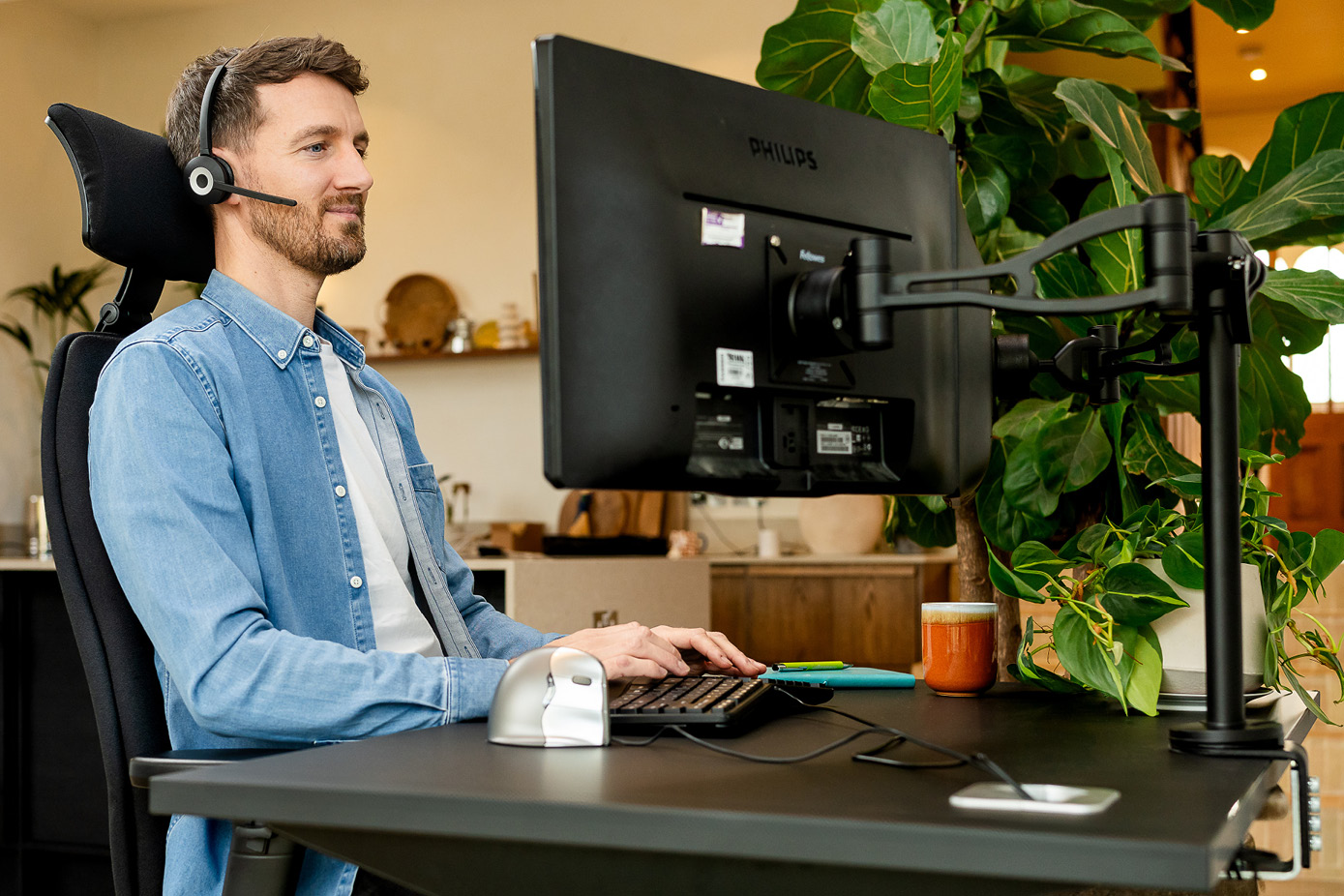
Easy adjustments like these can make a real difference at work to help prevent or reduce migraines, as Senior Information and Support Advisor at The Migraine Trust Oscar Harvey points out:
Movement and breaks
Despite all this brilliant progress with the desk posture and workstation setup, even with the best setup we need to move away from it regularly. Even excellent posture can be a migraine trigger if held onto for too long. We need to release physical tension.

Aim to move every 20 minutes when doing desk or screen work. It can be a swift microbreak of only 30 seconds to two minutes. Go and grab a glass of water, take a look out of the window, go and speak to a colleague; mix it up. Then also take at least one longer movement break, such as to go for a walk at lunchtime.
How moving more can help with migraine:
- Eases the strain: Sedentary work at a screen puts pressure on your neck and shoulders, a known route to migraine. Lack of movement can lead to muscular aches and pains.
- Reduces stress: A short stroll or a few minutes away from your desk can take the edge off work stress, a very common migraine trigger. Maybe take a moment to close your eyes and take a slow few deep breaths between tasks or after a stressful situation.
- Keeps things flowing: Regular movement keeps stiffness and fatigue at bay by getting your blood moving.
Moving away from the desk frequently is one of the healthy habits recommended to help prevent headaches as well as migraine.
Note that during an attack, migraine can be made worse by movement, which differentiates it from other types of headache disorders.
Migraine-friendly workplaces: regulation and rights

If an employee’s migraine attacks are frequent or if the symptoms are severe, then under the Equality Act 2010, migraine can be considered a disability. A team member’s ability to do normal daily activities such as talking on the phone, working on a computer, going for a walk, and driving could be severely restricted by migraine.
This can mean that there is a responsibility for the employer to put in place reasonable adjustments and potentially record sickness absence due to migraine differently:
“Sometimes an employer can either write off a certain amount of absence due to migraine or may record that absence due to migraine in a separate way: so it's still recorded as sick leave, but in a separate place to the standard” comments Emma from The Migraine Trust.

It's estimated that the UK loses £5.6 billion of output a year to migraine-related absenteeism and presenteeism, but the figure could be cut substantially if people with migraine are supported at work.
Some of the top reasonable adjustments that people with migraine told The Migraine Trust help them at work include:
- Changes to overhead lighting such as softer and diffused lighting, dimmable lamps and access to natural light. “I can't be in a room with old-fashioned strip lights” is not an uncommon experience.
- Anti-glare screens and anti-glare mats on reflective white desks.
- Access to a quiet room.
- The opportunity to work from home.
One of my colleagues also keeps a cool pack for the neck in the fridge at work and at home as she finds this useful for migraine.
As an employer, you can demonstrate your commitment to supporting the needs of staff living with migraine by signing The Migraine Trust’s Workplace Pledge. You can also book a Migraine Awareness Session delivered by experts from the charity for your teams.
How can you support a colleague living with migraine?

Above all, believe them when they tell you they are affected by migraine symptoms. Show them that you understand the difficulties and that the pain is real. Don't minimise it. “It’s sad how debilitating migraine is for us and my GP just thinks I have a headache” commented one lady living with migraine during the webinar.
On a more practical level, if there’s a desk in the office that has been set up to be migraine-friendly, help your colleague to access it and explain to others their strong need for it. Fetch them some water and anything they need if they're feeling like a migraine is coming on, or help them to the bathroom. Have empathy if your colleague is physically sick. Understand that they may still need support after the main stage of a migraine has gone.
Key takeaways
Your desk posture and setup won't be the only reason a migraine strikes, but it's one of the few triggers you can do something about. Because neck and head pain share the same nerve pathway, easing tension in your neck and shoulders is a sensible place to start. Physical ergonomics is useful here.
To recap: get your chair, screen, keyboard and mouse into positions that keep your shoulders relaxed, ensure your back is supported and move every 20 minutes, even if it's just for a glass of water and a look out of the window. Whatever you change, keep seeing your doctor for personalised advice and treatment and understand help will not be a ‘one size fits all’. People with migraine experience a range of triggers, and find different adjustments support them. It may be trial and error to find what works best for you.
If you're an employer or HR professional, a DSE Assessment is a great way to find out what individual employees need, and The Migraine Trust's Workplace Pledge shows your team you take migraine seriously. And if you're a colleague, simply believing someone when they say they're in pain will be very much appreciated.
Thank you to Oscar and Emma from The Migraine Trust for sharing their expertise here. This British charity campaigns for and empowers people affected by migraine, raises awareness of migraine, provides information and support, and funds and promotes new research. Their free, confidential helpline can be contacted on 0808 802 0066.
Read next: